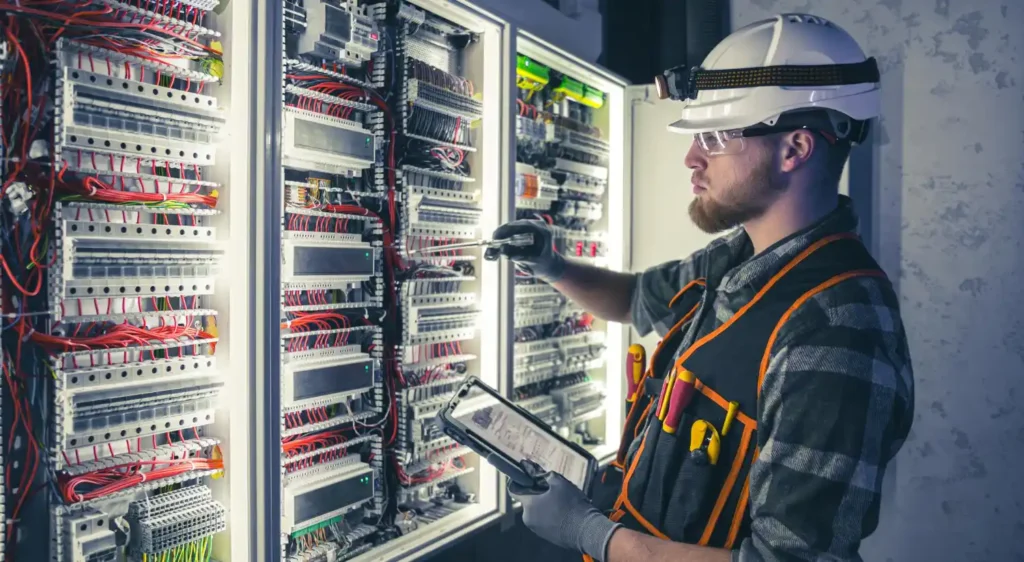
In a secure, undisclosed location, a team of engineers stares at a gigantic wall of screens. The room is quiet, but the tension is palpable. This is the nerve center of the UK’s energy system. It is the Electricity System Operator (ESO) control room.
From this single room, a small group of people manages the flow of high-voltage electricity for the entire country. Their job is simple to state but incredibly difficult to execute: they must match supply with demand, second by second, 24 hours a day, 365 days a year.
If they fail, the lights go out. If they fail badly, the physical infrastructure of the grid could be damaged permanently.
The Heartbeat of the Grid: 50Hz
To understand what happens in this room, you have to understand frequency. The UK grid operates at a frequency of 50 Hertz (Hz). This is the heartbeat of the system.
Think of it like riding a tandem bike. If the riders (generators) pedal at the exact same speed as the wheels turn (demand), the ride is smooth. If people start pedaling too fast, or if the bike goes uphill and slows down, you lose balance.
In the control room, 50Hz represents that balance. If demand rises say, millions of people wake up and turn on lights the frequency dips. If generation rises say, a sudden gust of wind hits the offshore turbines the frequency spikes.
The control engineers have a legal obligation to keep this frequency within a strict variance of plus or minus 1 percent. In reality, they keep it much tighter than that. They watch the digital counters relentlessly. If it drops to 49.8Hz, they act. If it hits 50.2Hz, they act.
Predicting the Unpredictable
You might think energy demand is chaotic, but it is actually remarkably predictable. Humans are creatures of habit.
The control room runs on data. They have massive databases of historical usage. They know exactly how much power the country uses on a rainy Tuesday in November compared to a sunny Sunday in July.
They factor in everything:
-
Weather: Temperature, wind speed, and cloud cover are critical. A drop of a few degrees Celsius can trigger thousands of electric heaters.
-
School Holidays: Demand patterns shift completely when kids are not in school.
-
Lighting: They know the exact minute sunset occurs across different parts of the country.
But the most famous variable is the “TV Pickup.” This is a uniquely British phenomenon. When a popular soap opera ends or a major football match goes to halftime, millions of people perform the same action simultaneously: they go to the kitchen and switch on the kettle.
This creates a sudden, massive spike in demand. It can be upwards of 1-2 Gigawatts in minutes equivalent to the output of a nuclear power station. The engineers in the control room sit with the TV schedules on their desks. They watch the clock. Just before the credits roll, they instruct pumped storage hydro plants in Wales to open their valves, flooding power into the grid to catch the surge exactly as it happens.
The Balancing Mechanism
When the forecast is wrong, or a power station trips offline unexpectedly, the engineers turn to the Balancing Mechanism. This is a marketplace for electricity flexibility.
It works like a live auction. The control room puts out a call: “We need 500MW of power, now.” Generators bid to provide it. It might be a gas plant offering to ramp up, or a battery storage site offering to discharge.
Conversely, if there is too much power perhaps it is a windy night and demand is low they pay generators to turn off. It sounds counterintuitive to pay a wind farm to stop spinning, but it is necessary to protect the system from overloading.
This is where the job gets stressful. The engineers are spending public money. Every decision to buy or sell power ultimately ends up on consumer bills. They have to balance safety with cost efficiency in real time.
The Green Challenge
The job has changed dramatically in the last decade. Twenty years ago, the grid was fed by a handful of massive coal and nuclear plants. They were big, heavy, and predictable.
Today, the grid is fragmented. We have thousands of wind turbines and millions of solar panels. This renewable energy is clean, but it is volatile. You cannot simply tell the wind to blow harder because it is halftime in the World Cup.
This shift has created two new problems for the control room:
1. Visibility A massive coal plant is easy to see on the sensors. Rooftop solar panels on a million homes are invisible. The control room sees them as a drop in demand rather than a source of supply. When a cloud passes over a city, that “demand” suddenly shoots back up as the solar generation vanishes. The engineers now rely on sophisticated AI and satellite weather data to predict these shifts.
2. Inertia Big spinning turbines in coal and gas plants provide “inertia.” They act like a heavy flywheel. If something goes wrong, their physical momentum keeps the grid spinning for a few vital seconds, giving safety systems time to react. Wind turbines and solar panels do not provide this natural inertia.
As the grid gets greener, it gets lighter and faster. The frequency moves more violently. This means the engineers have less time to react. They now rely on new, ultra-fast batteries and synthetic inertia services to keep the system stable.
The Human Element
Despite all the AI, algorithms, and automated systems, the grid is still run by humans. The control engineers undergo years of training. They are certified to make decisions that could blackout a city to save the country.
It is a high-pressure environment. During a storm or a technical failure, the alarms can be relentless. The team must filter out the noise, identify the root cause, and issue commands to power stations and substations across the UK.
They are the silent guardians of the economy. Most people never think about the electricity grid until it fails. For the team in the control room, a boring day is a good day. It means they have done their job perfectly, keeping the heartbeat of the nation steady at exactly 50Hz.